AI Red Teaming & LLM Security: An Honest Practitioner Review (2026)
Bottom Line Up Front: If you already write Python and want production-grade defense against prompt injection, RAG poisoning, and agentic tool abuse without paying $1,100–$3,500 for a proctored cert, this text-first masterclass is unusually thorough—just skip it if you need video lectures.
What Does AI Red Teaming & LLM Security Actually Cover?
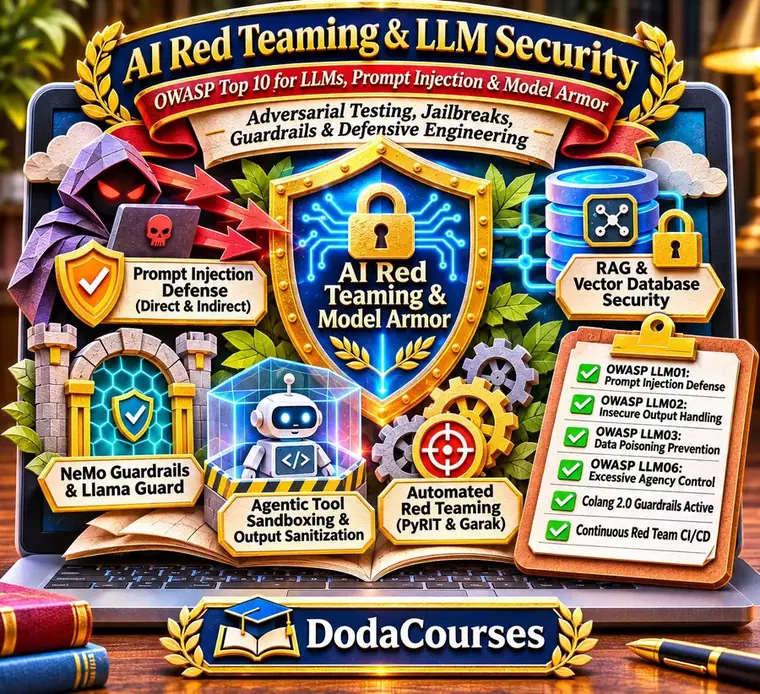
AI red teaming evaluates probabilistic LLM systems, RAG pipelines, and autonomous agents against adversarial manipulation rather than traditional code-only CVEs. This curriculum maps directly to the OWASP Top 10 for LLM Applications, MITRE ATLAS, and NIST AI RMF across 28 technical lessons.
Most introductory AI security tutorials stop at clever chat jailbreaks like “ignore previous instructions.” In real production apps, the dangerous failures happen deeper in the stack: indirect prompt injection hidden inside PDFs, poisoned vector embeddings, unsafe SQL/shell execution from model output, and overly permissive agent tools.
What stood out during our inspection is that the course pairs every offensive attack technique (PyRIT, Garak, TAP, GCG optimization) with concrete defensive engineering—such as NVIDIA NeMo Guardrails, Meta Llama Guard 3, AST validation with sqlglot, and Linux Seccomp / gVisor sandboxing.
Example From the Curriculum: Why Prompt Rules Alone Fail (OWASP LLM05)
Relying on a system prompt like “only generate SELECT queries” is not a security boundary against Improper Output Handling (LLM05). An attacker can bypass natural-language instructions via indirect injection and coerce the model into emitting destructive SQL or chained statements.
Rather than trusting the model, the defensive pattern taught in this curriculum treats LLM output as untrusted input and validates the Abstract Syntax Tree (AST) before any database driver executes it:
import sqlglot
from sqlglot import exp

def assert_safe_readonly_sql(raw_sql: str) -> str:
    parsed = sqlglot.parse(raw_sql)
    if len(parsed) != 1 or not isinstance(parsed[0], exp.Select):
        raise ValueError("Blocked: only single SELECT statements permitted")
    for forbidden in (exp.Insert, exp.Update, exp.Delete, exp.Drop, exp.Command):
        if parsed[0].find(forbidden):
            raise ValueError(f"Blocked forbidden AST node: {forbidden.__name__}")
    return parsed[0].sql()
$ python test_ast_guard.py
[PASS] SELECT id, name FROM users WHERE active = 1;
[BLOCKED] SELECT * FROM users; DROP TABLE audit_logs;-- → ValueError: Blocked: only single SELECT statements permitted
Seeing concrete, copy-pasteable engineering guardrails like this—instead of vague slide advice—is what separates a usable AppSec reference from generic AI blogs.
Who Needs This Course—and Who Should Skip It?
This course is engineered for working AppSec engineers, AI/ML developers, and DevSecOps teams shipping LLM features into production. It assumes you already understand HTTP, JSON, REST APIs, basic threat modeling, and can read Python 3.10+ scripts comfortably.
AppSec & Pen Testers: Translating traditional web exploitation skills into LLM threat modeling, indirect injection testing, and formal Rules of Engagement (RoE) reporting.
AI / ML Engineers: Hardening LangChain, LlamaIndex, RAG vector databases, and function-calling agents with Dual-LLM quarantine patterns and Pydantic invariants.
DevSecOps Engineers: Automating continuous prompt regression testing with Promptfoo and DeepEval inside CI/CD pipelines.
Security Architects: Aligning internal AI governance controls with MITRE ATLAS, NIST AI RMF, and EU AI Act obligations.
When to Skip This Course: Do not buy this if you learn exclusively from video lectures—the platform is strictly text-first and code-centric. Likewise, if you are brand new to Python or REST APIs, start with Microsoft’s free AI Red Teaming 101 series and Lakera’s Gandalf before tackling this material.
Inside the Syllabus: Topics, Toolkits & Deliverables
The curriculum spans 7 structured sections and 28 deep-dive lessons totaling over 48,000 words of technical instruction. Instead of short slide summaries, each lesson reads like an engineering reference manual backed by runnable Python implementations.
1OWASP Top 10 for LLMs (LLM01–LLM10) Attack & Defense
Alongside the 28 lessons, enrollment includes 6 module quizzes (30 scenario questions), 3 enterprise worksheets (Threat Modeling Matrix, Red Teaming Test Plan, Defense-in-Depth Checklist), and 3 production toolkits (NeMo/Llama Guard configs, PyRIT/Garak quickstart, and an Enterprise AI Security Policy template).
How Does It Compare to CAISP, OffSec OSAI & SANS SEC536?
Choosing the right AI security training comes down to whether you need a proctored exam badge for your resume or practical engineering patterns for your codebase. Here is how the leading options stack up in 2026:
Program
Typical Cost
Format
Best Fit
SANS SEC536
$2,629 – $3,505
2–5 day live instructor-led
Teams with corporate training budgets
OffSec AI-300 (OSAI)
~$1,749+
Self-paced labs + 24h proctored exam
OSCP-level offensive pentesters
Practical DevSecOps CAISP
~$1,099
Browser labs + 6h practical exam
AppSec pros wanting a hands-on cert badge
DodaCourses AI Red Teaming
One-time (30% off w/ FLAT30)
Text-first, 28 code-heavy lessons + toolkits
Engineers wanting deep defense/attack code fast
MS AI Red Teaming 101 / OWASP
Free
Docs, videos & gamified labs
Beginners exploring foundational terms
Free OWASP LLM Top 10 Pre-Production Checklist
Bookmark or print this 10-point AppSec gate before shipping any LLM feature or agentic workflow to production.
Key Takeaways
Production over hype: Goes far beyond basic chat jailbreaks into RAG poisoning, AST validation, and gVisor agent sandboxing.
Code-first format: 48,000+ words, Python scripts, and guardrails configs—ideal for engineers who prefer reading code over watching videos.
Smart cost trade-off: No four-figure proctored exam fee like OffSec or SANS, making it a strong self-funded option using code FLAT30.
Not for total beginners: Requires Python 3.10+, REST API fluency, and basic AppSec concepts.
Bottom line: If you build or audit LLM applications and prefer written engineering depth over video fluff, this is one of the highest-ROI self-paced references available.
Frequently Asked Questions
What makes AI red teaming different from traditional web pentesting?
Traditional web pentesting targets deterministic code flaws like SQLi or broken auth. AI red teaming tests probabilistic models, indirect prompt injection via RAG documents, embedding poisoning, and autonomous tool-calling permissions.
Who should take this AI Red Teaming & LLM Security course?
AppSec engineers, penetration testers, AI/ML developers building RAG or agentic pipelines, and DevSecOps engineers automating prompt testing—assuming you already know Python 3.10+ and REST APIs.
How does it compare to CAISP, OffSec AI-300, or SANS SEC536?
CAISP (~$1,099), OffSec OSAI (~$1,749+), and SANS SEC536 ($2,600+) focus on proctored exams or live cohorts. DodaCourses delivers a code-first engineering manual (48,000+ words) for self-directed learners at a much lower one-time price.
Is this a video course or a text-and-code curriculum?
It is strictly a text-first, code-centric curriculum with 28 technical lessons, Python scripts, guardrails configs, and module quizzes—not a video lecture series.
How do I apply the FLAT30 coupon code for 30% off?
Copy FLAT30 from the 3D discount card on this page and enter it at checkout on DodaCourses.com for an instant flat 30% discount.
RV
Reviewed by R. Verma • Security & Systems Reviewer
How we reviewed this course: We audited the complete 28-lesson curriculum structure, inspected the Python defense patterns (sqlglot AST validation, NeMo Guardrails, Seccomp sandboxing), and benchmarked pricing and format directly against CAISP, OffSec AI-300, and SANS SEC536. Updated November 2026.